The Growing Importance of IoT Cybersecurity
Çağatay Büyüktopçu, General Manager of CyberWhiz, discusses the rapidly growing number of IoT (Internet of Things) devices and the impact of this growth on cybersecurity in an interview with Wise TV. He explains why IoT security has become a critical priority in a world where more than 50 billion devices are projected to be connected to the internet by 2030.
First, I would like to address the growing importance of IoT cybersecurity. As we know, the number of connected devices is increasing exponentially day by day. We live in a world where at least 127 devices connect to the internet every second, and it is predicted that over 50 billion devices will be part of our lives by 2030. Alongside this increase in volume, the technical diversity of these devices is also expanding significantly. They connect to the internet using various software and hardware infrastructures; some utilize Bluetooth, others Wi-Fi, and some rely on GSM networks. It will not be enough for IoT devices to simply possess a secure, end-to-end ecosystem of their own. They will begin communicating with one another, with electrical grids, with vehicles approaching a home, and so on. This will exponentially expand the attack surface that must be managed regarding IoT cybersecurity. There are a few areas where IoT cybersecurity presents greater challenges compared to IT and OT. The first is that the network is not under our control. While it is relatively quick and easy to take action in response to an incident within an IT environment—such as rebooting a server or migrating it—or to implement preventive measures for a cyber incident in an OT or factory setting—such as isolating the affected network—taking similar action for IoT devices scattered across millions of streets and homes is far from simple. Replacing an electronic circuit board, performing a reboot, removing and reinstalling a component in an electric vehicle, directing a device to a service center, or even—at the very least—deploying updated security software via an over-the-air update to millions of devices in the field can result in significant financial and reputational damage for the manufacturer.
IoT and Cybersecurity: Rising Threats and Solutions
Today, the number of IoT (Internet of Things) devices is rapidly increasing, creating new challenges in the field of cybersecurity. With new devices connecting to the internet every second—and projections suggesting there will be over 50 billion devices in our lives by 2030—security vulnerabilities in this sector are also on the rise. The technical diversity of IoT devices and their varied connectivity methods make securing them increasingly complex.
Diversity of IoT Devices and Connectivity Methods
IoT devices connect to the internet using diverse software and hardware infrastructures. They communicate via various methods such as Bluetooth, Wi-Fi, or GSM. This diversity necessitates the development of more complex strategies to ensure device security.
The IoT Device Security Ecosystem
It is not enough for IoT devices to possess an internal, end-to-end secure ecosystem. As these devices begin to communicate with other systems—such as electrical grids or vehicles approaching a home—security vulnerabilities multiply. This exponentially expands the attack surface that must be managed regarding IoT cybersecurity.
Differences Between IoT and IT/OT Security
IoT cybersecurity presents greater challenges than IT (Information Technology) and OT (Operational Technology) security. In an IT environment, action can usually be taken quickly and easily. However, because IoT devices are distributed across millions of different locations, taking such actions is far more difficult. Security Updates for IoT Devices
Implementing security updates for IoT devices can pose significant financial and operational challenges for manufacturers. Deploying up-to-date security software across millions of devices is a process that demands both time and resources. Therefore, developing effective and sustainable security solutions is of critical importance for manufacturers.
Future Challenges in IoT Security
As the number of IoT devices grows, ensuring their security will become increasingly difficult. In the future, the development of more advanced and innovative solutions will be required to secure these devices. This will present a significant challenge for both device manufacturers and cybersecurity experts.
Successful Strategies for IoT Security
Collaboration between device manufacturers and cybersecurity experts is essential for achieving success in IoT security. To minimize vulnerabilities, security measures must be integrated from the design stage and supported by continuous updates. Furthermore, raising user awareness and providing education on security matters is crucial.
IoT cybersecurity is a vital issue in the rapidly evolving world of technology. The rising number of devices and the expansion of technical diversity increase the risk of security vulnerabilities. Consequently, developing and implementing effective security strategies is critical for both manufacturers and users. In the future, the development of innovative IoT security solutions will help overcome the challenges facing this field.
About the Wise

Similar Videos from this Wise
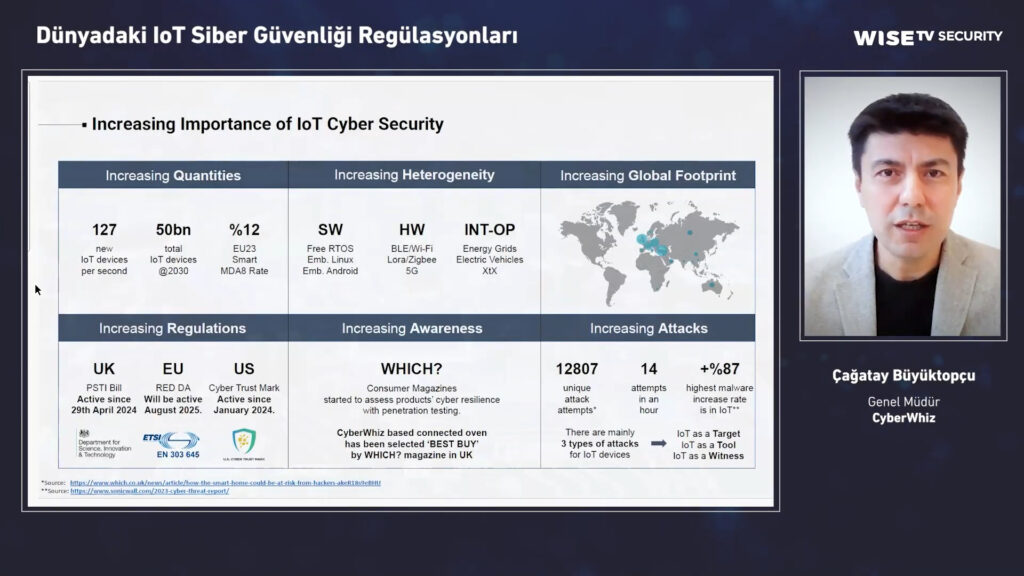
IoT Cybersecurity Regulations Worldwide
Çağatay Büyüktopçu, General Manager of CyberWhiz, discusses global regulations regarding IoT device security and significant...
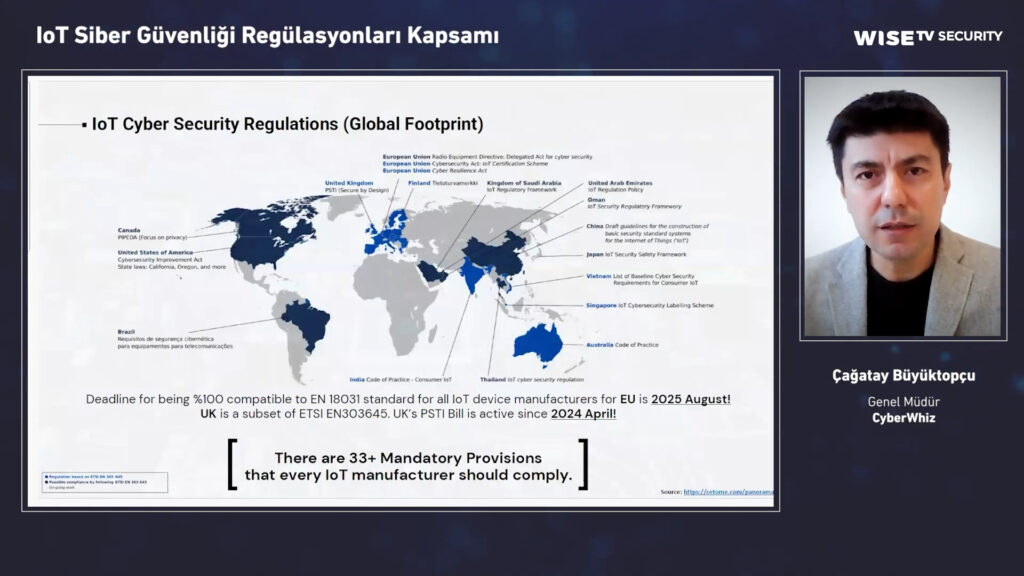
Scope of IoT Cybersecurity Regulations
CyberWhiz General Manager Çağatay Büyüktopçu noted that the countries marked in blue have announced IoT cybersecurity regulat...

CyberWhiz – IoT Cyber Security Solutions
Çağatay Büyüktopçu, General Manager of CyberWhiz, stated that they manage a company focused on IoT cybersecurity. Çağatay Büy...

The 3 Pillars of End-to-End IoT Cybersecurity
Speaking to Wise TV, CyberWhiz General Manager Çağatay Büyüktopçu emphasizes that for a sustainable cybersecurity infrastruct...
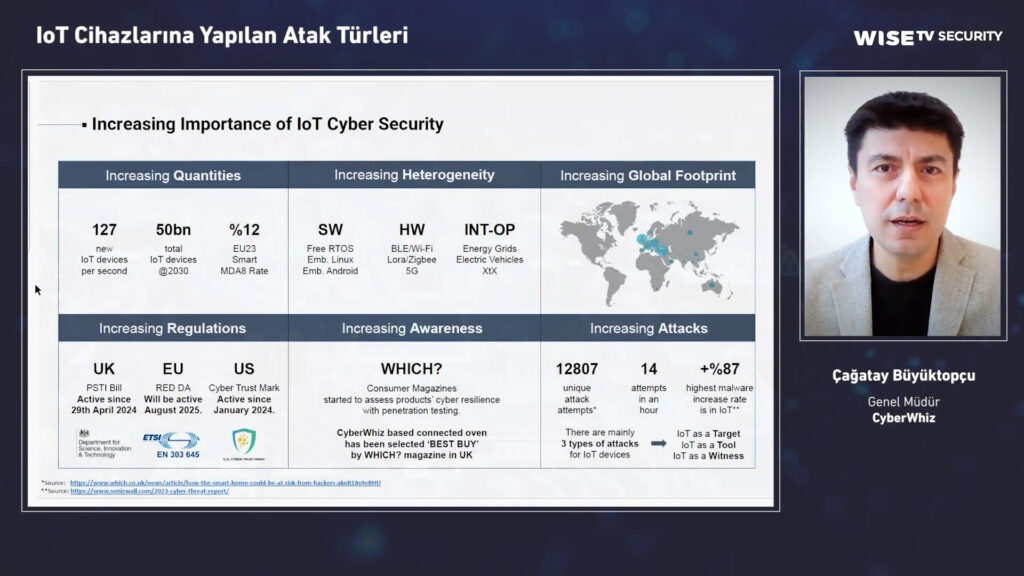
Types of Attacks on IoT Devices
CyberWhiz General Manager Çağatay Büyüktopçu talked about malware production and cyber security measures for IoT devices. Çağ...