CyberWhiz General Manager Çağatay Büyüktopçu talked about malware production and cyber security measures for IoT devices.
Çağatay Büyüktopçu said:
Malware Threat and Cyber Security Measures in IoT Devices
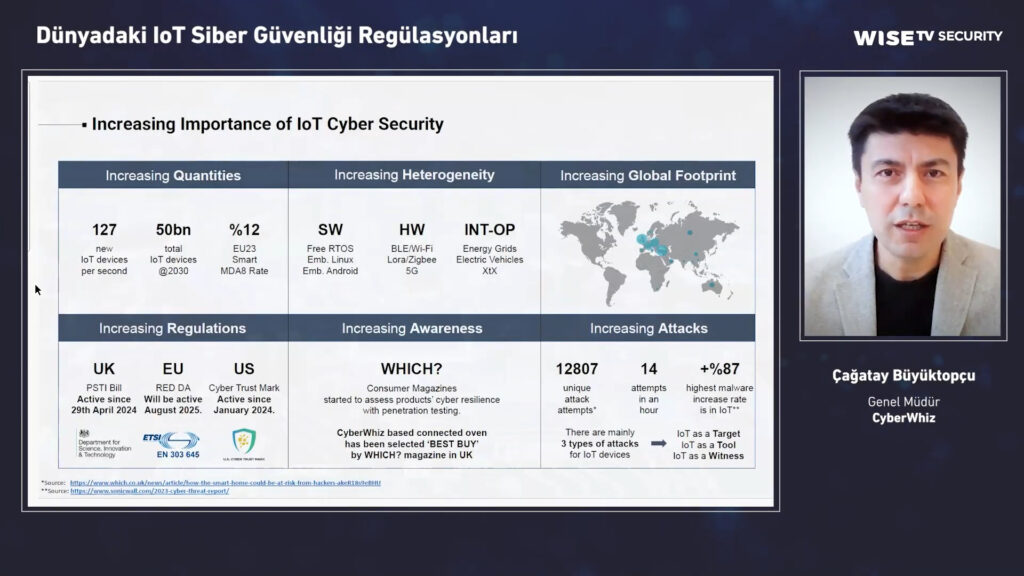
In recent years, the rate of malware targeting IoT (Internet of Things) devices has increased noticeably. An 87% increase was observed especially in the IoT domain. Attacks on IoT devices generally occur in three different ways: IoT As a Tool, IoT As a Target, and IoT As a Witness.
IoT As a Tool: IoT as a Tool
In such attacks, while IoT devices continue their normal functions, they are used by malicious people in the background to attack other targets. The Mirai botnet attack, which took place in 2016, is one of the most well-known examples of such attacks. Russian hackers installed malware on IoT devices whose passwords were simple such as “admin”, “admin” or “123456” and were not changed after purchase, activating these devices simultaneously and causing large companies to experience service outages. This incident marked a major milestone in the field of IoT cybersecurity.
IoT As a Target: IoT as a Target
In 2017, hackers began organizing attacks to take control of IoT devices. A toy was hacked in Germany and direct communication was possible with children playing with this toy. Following this incident, the German government decided to recall the toys.
IoT As a Witness: IoT as a Witness
The third type of attacks targets personal and private information produced by IoT devices. This information can be obtained through the device or cloud/mobile application and used for blackmail. For example, images leaked from an American robot vacuum cleaner company’s camera robot vacuum cleaner reveal the seriousness of such attacks.
The Future of IoT Cybersecurity
In light of these trends and realities, IoT cybersecurity is predicted to be a critical need for the next 10 years. To ensure the security of IoT devices, designs that comply with regulations must be made. Additionally, cyber security of mobile applications should also be taken into consideration. For example, in 2022, Hyundai’s mobile application was hacked and vehicles around the world became remotely controllable.
As a result, IoT and mobile application security is becoming more important with the increasing number of devices and applications. The measures to be taken in this area will play a critical role in ensuring the security of both individuals and companies.
About the Wise

Similar Videos from this Wise

The Growing Importance of IoT Cybersecurity
Çağatay Büyüktopçu, General Manager of CyberWhiz, discusses the rapidly growing number of IoT (Internet of Things) devices an...
IoT Cybersecurity Regulations Worldwide
Çağatay Büyüktopçu, General Manager of CyberWhiz, discusses global regulations regarding IoT device security and significant...
Scope of IoT Cybersecurity Regulations
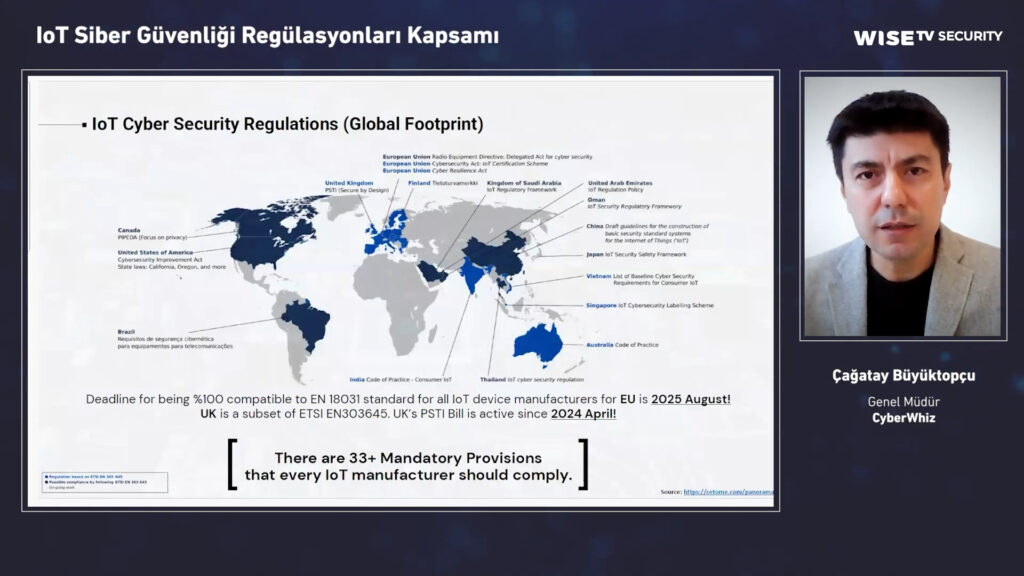
CyberWhiz General Manager Çağatay Büyüktopçu noted that the countries marked in blue have announced IoT cybersecurity regulat...

CyberWhiz – IoT Cyber Security Solutions
Çağatay Büyüktopçu, General Manager of CyberWhiz, stated that they manage a company focused on IoT cybersecurity. Çağatay Büy...

The 3 Pillars of End-to-End IoT Cybersecurity
Speaking to Wise TV, CyberWhiz General Manager Çağatay Büyüktopçu emphasizes that for a sustainable cybersecurity infrastruct...