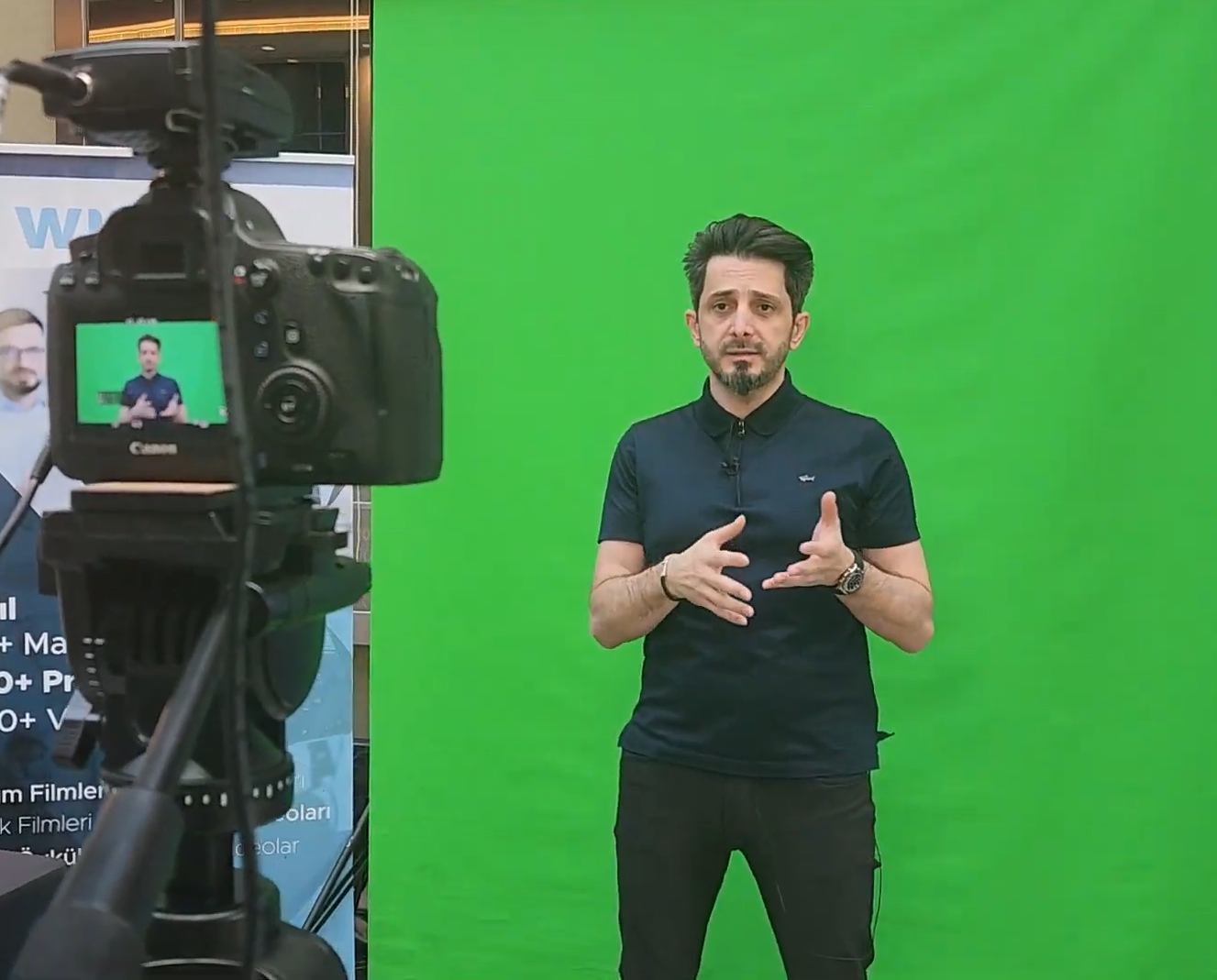
Hello. Today we are with Mr. Avni in the Digital Studio. He is the Vice President of the Turkish Confederation and also the head of the digital transformation commission. We will be evaluating digital transformation in the industrial production sector, what it brings to both senior management and employees, and what companies should do in this area. Welcome, Mr. Avni. How are you? I’m fine. Thank you for inviting me. These economic conditions are very challenging for all of us. On the other hand, of course, we also need to keep up with the world. Inevitably, all sectors are showing development. Industrial production is one of those experiencing this even more. We are talking about a sector where there is a large number of blue-collar workers, but also a significant transformation driven by technology. We recently published a technology report. It’s published globally. A version that we evaluated with our clients in Türkiye will also be released soon. I would like to start with a question based on that report. Of course, one of the critical things here is that while we are transforming technology, our transformation of people is also very critical. The concerns of senior management, in particular, are: can we keep up with this transformation? During this process, there are many concerns, such as whether there will be a loss of speed in production, or whether there will be disruptions due to adaptation. And this leads to two types of results in a high percentage, around 80%. One concern is whether we are missing out on this digital transformation. On the other hand, there is concern from two perspectives: are we falling behind the competition in this context? There is both anxiety and motivation to keep up. During these back-and-forth movements, do you think a real loss is occurring? Or is it accelerating with this motivation? Or would falling behind cause any disadvantage? Could you comprehensively evaluate the technological transformation, the digital transformation? The question contains the answers within itself. Senior management needs to believe in it. Senior management, generally representing an institution dealing with SMEs, generally viewed these as somewhat of an expense item until recent years. Of course, they have daily needs. Related to access to finance, related to inventory, related to production. In areas where these were prioritized, technological transformation, digital transformation, was somewhat postponed. But the gap has widened so much – the gap between those who started early and those who haven’t yet undergone technological transformation – and the increase in productivity and the competitive advantage they’ve gained is so great that everyone wants to take a step forward. This starts with top management believing in it. How can we convince top management? Frankly, by clearly demonstrating the increase in productivity, the cost savings, and showing how our competitors have gained a competitive advantage through examples, top management needs to believe it. Of course, there’s always resistance from the employees. Everyone wants to continue working the way they do. From this perspective, it’s not enough to just buy technology or software; the transformation doesn’t happen. This is a holistic issue. Top management needs to believe in it from top to bottom, and then train their other personnel and team members accordingly, convincing them as well. Because this gap is widening, those who fall behind will also have to allocate more resources. Unfortunately, the economic climate means everyone’s priorities are very different, so instead of postponing, I think we need to first assess the situation. They themselves may be slightly involved in the technological field. First, they need to assess the current situation, then create a roadmap, and proceed step by step. There’s nothing to be overly afraid of, but falling behind is frankly much more concerning. To use an analogy, imagine an object approaching in terms of technology, and we can’t really miss out on that. Otherwise, we start falling behind in the competition. Production speed decreases, and so on. On the other hand, when we look at the manufacturing sector in Türkiye in general, considering the profile of companies and employees, the need to increase corporate memory becomes apparent. Because employees are very experienced, those valuable people, but after a certain point, they will inevitably return to their private lives, so there is a need to transfer that know-how in some way. This usually happens through technology. Among today’s technologies, there is artificial intelligence, which is talked about everywhere. Of course, we talked a lot about artificial intelligence in the digital studio. We also talk about it at many events. Artificial intelligence has become a topic of discussion in every sector. Of course, the increased prominence of productive artificial intelligence has led us to talk about the term artificial intelligence more often. Does the same apply to the industrial manufacturing sector? In which areas has it started to be used more? Is this awareness new? Has it always existed? Actually, with Industry 4.0 and data collection in production, these things started, albeit gradually. Artificial intelligence has taken this to a different level. In particular, AI has made the collected data more meaningful. This isn’t just about production speed. We observe that the use of AI has a positive impact on companies in areas such as raw materials used, making predictions about supply chains, and energy savings. It has become particularly prominent in maintenance costs, for example, because it can collect significant data from all production processes and sensors. However, AI has developed mechanisms to warn companies early on, saying things like, “If you don’t pay attention, this part of the production will stop, this part will malfunction.” So, compared to a company without such a warning mechanism and one using AI, some might need to stop production for minutes or hours, while others can foresee and plan accordingly, adjusting their production line and perhaps continuing without interruption. They might even adjust their supply chain accordingly and continue without stopping. On the other hand, we can say that artificial intelligence is very prominent in terms of quality control. Especially in very critical sectors such as aviation, defense industry, or microchip production, the quality of production needs to be almost zero defects. Artificial intelligence, perhaps through image processing, can excel in quality control in areas that the human eye and some machines cannot detect. On the other hand, in a world where end-to-end systems in supply chains communicate, artificial intelligence makes things much more visible and predictable, such as raw material development, inventory planning, production planning, and sales forecasting. Therefore, you also have the chance to reach the customer whenever you want. On the other hand, the compatibility between humans and artificial intelligence is also very important. That is, human-robot compatibility is also very important. It also comes to the forefront. Especially by leaving routine, repetitive tasks to robots, to AI-powered robots, it enables people to be used in more value-added jobs, in jobs where they can use their creativity more. In this respect, there is actually a fear that artificial intelligence will take our jobs. No, it won’t actually take them, but it will be a good team player for us. We need to look at it from this perspective as well. Productive artificial intelligence may sit on our boards tomorrow or the day after, we don’t know. There are examples of it on boards of directors in the world. It has slowly started. Maybe it will sit on boards of directors, but of course, I don’t think it is very likely that it will replace the environment in which we are currently communicating with humans. It will only do routine tasks. It will make some of our tasks much more efficient. It will also help us save more money, as it does now. But I think positioning it as a good team player and changing our company and production strategies accordingly would be a good solution. We’ve been talking about digital transformation. We’ve mostly talked about artificial intelligence, which always comes up in many reports. At that point, you also connected it to IoT and Industry 4.0. That’s very true. Because without that data, we can’t use or enable any of what we’ve mentioned. From here, I want to move on to the topic of smart factories. Of course, we always talk about factories, but you mentioned a value chain. That is, the customer will have a demand. We will convert that demand into a sale. Therefore, this will actually affect our production. You also mentioned maintenance to meet that production and customer demand on time. These are all interconnected things, and when we connect them all in a chain, we wish there were something smart that would plan everything for us point by point. And that plan, as we say, is what smart factories are all about. It even goes so far as to have digital twins, where certain scenarios are built upon them, and where scenario-based planning is developed to address any disruptions or unexpected situations. All of this is driven by digitalization. For example, if we were to write down a customer request in a notebook, we would need to find those notebooks. All vendors would need to use them, and from there, planning would have to begin. Digitalization is now, in my opinion, widely accepted. I’m sure many of these conversations are being discussed by managers and employees of various organizations on different platforms, but what are the critical success factors here? Because there are areas where this is not being done. You are one of the managers who have experienced this. What advice would you give to other managers here? First of all, a smart factory shouldn’t just be about technology investment. The human factor is paramount, and perhaps the company’s culture needs to allow for it. It all starts with top management believing in it and convincing all levels of management. On the other hand, I think successfully integrating artificial intelligence, robots, humans, sensors, and managers in a holistic way is one of the critical success factors. Digital transformation also doesn’t end with buying technology and training people, unfortunately. It’s a long journey. Because technology is constantly changing, and we really need to create self-learning mechanisms, learning management boards, learning platforms, and learning robots. This is one of the areas where artificial intelligence plays a critical role. The ability to quickly adapt technology is actually important for companies to survive and remain competitive in the long term. On the other hand, smart factories have almost put data management in the leading role of decision-making mechanisms. They make decisions based on data because they have real data. As I mentioned, in terms of supply, raw materials, energy efficiency, efficient resource utilization, and logistics, having all the data from the beginning allows you to make more scientific and data-driven decisions. This data then enables you to make more accurate decisions regarding future investments, new customers, and new production lines. It’s crucial to structure the human-machine interaction very well. You need to direct people towards more value-added tasks while leaving routine tasks to the machines. This also requires a good education policy. In fact, sometimes the trainings given can be seen as a cost item, but these trainings can actually be vision-opening trainings so that the upper management, managers and our teammates can follow the technology faster and follow the world faster. In this respect, it is very critical for human resources to be trained correctly and to be able to quickly adapt to the qualities of our age. Of course, when talking about smart factories, the topic of cyber security also comes to the fore. As IoT technology grows, it is now necessary to defend the entire field. Because, from the beginning, if there is smart management in all supply chains, it is necessary to defend all supply chains. Likewise. For this reason, cyber security strategy is actually one of the indispensable parts of smart factories. Maybe it’s an overlooked issue, but the cost of this is too high. If we encounter a cyber attack. In this respect, I think that security measures should be taken gradually in all supply chains and a very serious strategy should be developed regarding this. I think it is very important to develop an absolute strategy regarding cyber security, both individually and in the industry, and take action regarding it, especially considering that the coming IoT will penetrate our homes even in individual senses. I liken this cyber security issue to something else. Now, what do we do when we automate, that is, robotize, or turn the system into a way that works on its own with software, plans and ensures the continuity of production? We direct people to more value-added jobs. We are leaving the machines with the power or manual control of the thing with no added value. Occupational health and safety is something similar for our Blue Collar friends who are currently working with a cyber security issue for those machines. TRUE. We replace it with that. So, cyber security is now positioned instead. These are actually things that should happen due to the nature of the job. So, this is one of the benefits of smart factories. It’s about occupational health and safety. We no longer need to think as much as we used to. Because we left routine work to people. However, what is needed is to leave occupational health security to cyber security, as in the gap you left. You expressed it very accurately. Exactly. Of course, there are other benefits there as well. Besides financial gains, optimization, and the like, there are also other benefits aimed at protecting human health. Of course, there’s a balance to be struck, a calculation of that benefit, a balance of added value. It doesn’t mean everything. When we talk about digitalization, we can include many things like smart factories and the like. It’s always about taking X software, deploying it, and making it work. Yes. Now it’s digitalized. Generally, these things always start with ERP. Of course, finance, accounting, banking integration, payment systems – ultimately, you need money in the till. This is, of course, a core, fundamentally important thing. And yet, we consider that as digitalization. That’s how some institutions see it. Or, when we add other complementary peripheral technologies, then we say, “Yes, we’ve digitalized.” But unless you integrate these, to ensure that the entire value chain, from the creation of the opportunity to the delivery of the final product, remains unbroken, these systems need to be integrated, and perhaps that’s where most of the time is spent. So, looking at your experiences, do you have a different perspective here? I was curious about that. Frankly, companies often make digitalization investments without being aware of their own specific needs. It’s usually done through references. For example, “Our friend’s factory made this investment and it’s become quite efficient.” But that’s not always the case. Every need is different. Every company is different. Therefore, an example that’s right for one person might not be right for us. Firstly, will there really be a rift in upper management? That’s very critical. Because if there’s a rift, it can be manipulated very quickly. Someone might say, “Our senior manager told me to do the old version in Excel and then transfer it.” But when you do it in Excel, when you somehow revert to the old version, then the weakest link in the chain is broken. Upper management needs to believe in it. And digitalization can’t happen overnight. You need to create a culture of digitalization. The company needs managers who are self-taught, lifelong learners. This requires a thorough assessment of the current situation, and this is a common mistake: They might be making a huge investment, but perhaps that’s not what they really need initially. We need to develop self-awareness, and there are many tools available in the digital environment, and many companies offer services related to this. Where are you really? Where do you need to go? There are similar initiatives like the Turkish Federation of Tradesmen and Craftsmen (Türkfed) that create roadmaps for this. Working with such a partner, trusting them, can be the right approach. Then, proceeding step-by-step – it’s difficult to integrate the entire system at once – perhaps starting with a production line, then moving on to supply chain management. Doing it gradually, step by step, makes the process more efficient and feasible. But doing this from start to finish also requires trust. Because your raw material supplier, your logistics partner, your customer – all the systems related to this need to communicate with each other, and you need a long-term partnership based on mutual trust, or even if trust isn’t the case, a good IT strategy needs to be in place to plan which data areas will be shared. That’s why we always call it a long-term journey. Approaching it this way, from training to culture and every aspect of the supply chain, with a broad perspective and implementing a long-term strategy seems like the right choice to me. The choice to focus on this is very critical. As you said, every organization has different needs. Along with the IT strategy, there’s the business transformation strategy, and as we mentioned earlier, there’s also the cybersecurity strategy. Do you have any opinions on the steps that need to be taken or the points that need attention? Of course, we need to protect a very broad surface area related to cybersecurity and the entire supply chain. In the past, we just bought an antivirus program and used it on our own computers or servers. But now, all our data is in the cloud. We don’t know where our supplier’s data is. We can get instant data from it. That’s why we need to defend a very large surface. That’s why we need to be a little more proactive and close these plans early, before we even get to the security point, that is, before we get into an attack position. Which data will be shared with whom? If an employee of ours accesses data in the middle of the night, maybe we shouldn’t allow it. In other words, a zero trust policy should be essential. In cyber security, it may be necessary to purchase 2-3-tier security systems. On the other hand, there is an artificial intelligence issue that is waiting for us. While artificial intelligence makes our operations easier, unfortunately it also has a dark side. Deeptech technology is one of the important examples of this. Regarding this, we need to adapt our defense systems to EA and notice and detect these early. It has not yet come into personal use, but after quantum technology arrives, all the encryption systems we currently use will change and become completely ineffective. Regarding this, we observe this well and see where technology is heading? Frankly, we need to quickly integrate this into our cyber security policies. Also, I think it is important to establish autonomous systems without the need for human intervention. When there is a real cyber security attack, the system needs to detect it on its own and prevent it without a warning mechanism and without the need for human intervention. Because we will have open data 24/7 and systems that work 24/7. It may not always be possible to reach people. This is also very critical. Later, through reporting, we can of course share with the team that such an attack has occurred. So, regarding this, I made a lot of references to supply chains. It is also very important that we integrate our customer’s cyber security strategies and our supplier’s cyber security strategies. I think it would be very valuable to establish integrated systems that talk to each other and are even holistic, that is, looking at the supply chain from top to bottom. What is critical to my company that would cause problems for me if I lost it? Is this data? Production line stoppage? Anything else? We talked about people in this digital transformation. When we look at it from a cyber security perspective, it can cause harm to people there too. So, of course, what kind of production we do depends on how dangerous it is. It is necessary to think very thoroughly. Recently, this has especially affected resilience issues. If there is anything you would like to add here. So that’s what I was going to say. In fact, our age has turned into an age of endurance. This cyber resilience is the most important part of this. Because cyber attacks will reach a level that we will actually see even in our personal lives, perhaps in 5 years. In this respect, how quickly can we bounce back after receiving this cyber attack? This will be one of the most critical issues. We received a cyber attack. A security vulnerability has been found. A new technology has passed. We received the cyber attack. We’ve lost some meaningful data. When was the last time we could retrieve this data? Or how can we recover it? Are we doing this manually? Are we doing it with machines? Or do we have another alternative Plan B stored somewhere? Being able to remain operational despite receiving a cyberattack is quite valuable. Therefore, I think that cyber resilience, along with cybersecurity policies, will be one of the most important issues, including planning for what we can do after an attack. As we digitally transform, responsibilities increase somewhat. Absolutely. Now, Mr. Avni, if we were to talk a little about the future, what are your predictions regarding digital transformation or digital technologies in the coming period? What do you think awaits companies? If we could get your opinion on this as well. Of course, artificial intelligence is already indispensable; we can say that its areas of use will become very widespread. On the other hand, we will see that it can be used in maintenance, customer service, perhaps even chatbots, even on a small and medium-sized enterprise (SME) scale. I think that in the coming year, the use of artificial intelligence will increase significantly in the healthcare sector, the finance sector, retail, and manufacturing. On the other hand, hybrid working has become a reality. From this perspective, hybrid and cloud-based infrastructures will also be quite valuable. Our companies have now become more flexible and accessible. In this respect, I think that data security and hybrid working ERP systems will become widespread. On the other hand, as I gave an example in these smart factories, decision-making with data. As the system becomes smarter, our data becomes more meaningful. While it is important where and how we collect the data, artificial intelligence agents will emerge that will make this data meaningful and bring it to decision-making mechanisms. I think that the use of these will increase even more in senior management. Sustainability and green technologies are also indispensable. Carbon capture technologies, carbon neutralization technologies, and digitalization – in fact, as Türk Onfed, we always put forward the triple transformation vision: green transformation, digital transformation, and social transformation. These are inseparable. So, while making our green businesses carbon neutral, we will support energy saving, raw material use, and resource utilization through digitalization. On the other hand, human beings are indispensable, and with the change and transformation of humanity, these two will become even stronger. When we consider these three together, I believe that the technology decisions to be made should now be green, carbon neutral, and climate-friendly technologies. And finally, artificial intelligence will offer personalized customer experiences, especially in retail. Everyone, every consumer, will receive services tailored to them. Perhaps some e-commerce companies are implementing this very well, but we will start to see this on a smaller scale as well. For example, they will be able to suggest similar products much faster to a product we are looking at, or we will see it as a suggestion in our email or on different social platforms. This could be one of the areas where we will see its application in the coming year. We have discussed this a little bit here. When we look at the sector, although the industrial production sector is a sector with a higher number of blue-collar workers and a higher workload, we have assessed today that there is still much to be done and much more to be done in the digital realm. Of course, this brings other responsibilities, such as eliminating people’s anxieties, ensuring the motivation of senior management, initiating transformation from senior management, and so on. While there is a cultural transformation, we also discussed data, technology, but also cybersecurity, and consolidating all of these and empowering them all with artificial intelligence – creating opportunities while eliminating risks. Of course, sustainability is one of the most critical issues lately. We discussed whether we could support this with technology as well. Thank you very much for your valuable opinions. Thank you for your participation. In the digital studio, we talk a lot about digital transformation, technology, and of course artificial intelligence. Today, together with Mr. Avni, we evaluated the industrial production sector. Thank you.
Digital Transformation and Industrial Production
Today, digital transformation plays a significant role in the industrial production sector. With the rapid advancement of technology, companies are focusing on digital transformation processes to gain a competitive advantage and increase their efficiency. This process is not limited to technological investments but also includes the human factor. The belief of top management in this transformation and the adaptation of employees to this process are critical for a successful digital transformation.
Artificial Intelligence and Industrial Production
Artificial intelligence makes significant contributions to the industrial production sector in areas such as data analysis, quality control, and supply chain management. AI-powered systems optimize production processes, reducing costs and increasing efficiency. Furthermore, data collected through artificial intelligence becomes more meaningful and is effectively used in decision-making processes.
Smart Factories and Digital Twins
Smart factories are one of the most important elements of digital transformation. These factories use technologies such as digital twins and artificial intelligence to optimize production processes. Digital twins help to identify and solve potential problems in advance by creating a virtual copy of real-world production processes. In this way, production processes can be carried out more efficiently and without interruption.
Cybersecurity and Digital Transformation
Cybersecurity is a crucial aspect of the digital transformation process that should not be overlooked. With the widespread adoption of IoT technologies, a broader defense against cyberattacks is necessary. Therefore, it is important for companies to update their cybersecurity strategies and take proactive measures. Furthermore, cyber resilience plays a vital role in this process.
Human-AI Harmony
Yapay zeka ve insan uyumu, dijital dönüşüm sürecinde önemli bir faktördür. Rutin işleri yapay zeka destekli sistemlere bırakarak, insanları daha katma değerli işlere yönlendirmek mümkündür. Bu sayede, çalışanların yaratıcılıklarını kullanabilecekleri alanlar genişlemekte ve iş süreçleri daha verimli hale gelmektedir.
Gelecekte Dijital Dönüşüm
Human-AI harmony is a crucial factor in the digital transformation process. By entrusting routine tasks to AI-powered systems, it’s possible to direct people towards more value-added work. This expands the areas where employees can utilize their creativity and makes work processes more efficient.
Conclusion
Digital transformation is an inevitable process for increasing efficiency and gaining a competitive advantage in the industrial production sector. Artificial intelligence, smart factories, and cybersecurity play a significant role in this process. Furthermore, the human factor and cultural transformation are critical to its success. In the future, digital transformation processes will become even more widespread and will help companies achieve their sustainability goals.
About the Wise

Similar Videos from this Wise
HeloBot: A New Generation of AI-Powered Customer Assistant
Here at Wise TV, we take great pleasure in bringing you the most innovative solutions from the world […]