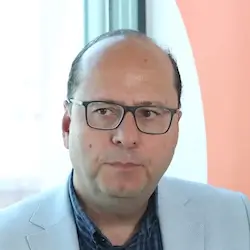
ERP Committee Coordinator M. Göker Sarp spoke about the role of ERP in institutionalization and digital maturity. Sarp said:
Hello everyone. Welcome to the new episode of Dialog Expert Talks. Today’s topic is actually a big one: ERP, and with me is Mr. Göker Sarp, the ERP committee coordinator. Welcome.
Hello.
How are you?
I’m very well.
Thank you very much for accepting our kind invitation and coming.
With pleasure, with pleasure. Always.
Could you start by briefly introducing yourself to our viewers?
Of course. I was born in 1969. I met the ERP world in 1991 as a software developer. I am a graduate of Istanbul Technical University, Department of Mathematical Engineering. As I said, this is my 34th year. Until then, I worked in various positions such as software development, consulting, and project management. Lately, I have been focusing more on increasing ERP awareness with the ERP committee. Furthermore, ERP alone isn’t the only software that can solve all of a company’s needs. Therefore, our journey, which began with ERP, has evolved into a corporate transformation platform encompassing other three-letter technologies like CRM, DPM, PLM, and most recently, RPA, all under the umbrella of various committees. The goal here is to introduce tools that support companies’ corporate development, raise awareness, and indirectly facilitate their digital and corporate transformation. Beyond that, for the past five years, I’ve also been providing business analyst training under the name BA Academy. We’ll discuss the integration of ERP and business analysis in more detail later on.
Okay. How was this ERP committee established? What were its goals?
It was founded in 2012. There was a need for it, so it grew rapidly. We currently have 15,000 members. This is our 13th year. We have representatives in cities with industry. We have working groups, sectoral groups. What we are trying to do is increase awareness about ERP. For those who don’t know: According to Turkish Statistical Institute data, the latest measurements show that the ERP usage rate is 29.7%. That’s an average, of course. So there are 3 segments. Businesses with 250 employees and above have a higher ERP usage rate. The medium and small segments. The smallest group, as you’ve seen in all the data, uses it the least. That is, small businesses, those with 50 employees and below. We embarked on this journey to increase this awareness. It grew very quickly. We reached 1000 members in 2 years. It has been continuing its growth for a long time. As I said, we have reached 15,000 members. Because digital transformation has become a more prominent topic lately, our membership numbers have also been steadily increasing. There are no membership fees. As long as you haven’t committed any shameful crimes, you can remain a member. You can participate in our events for free. What we do is essentially share valuable information that is independent of brand. Let’s say brands act as intermediaries. Our goal is to deliver information that will help with digital transformation.
We can also call it providing benefits.
Exactly, exactly.
Now, you mentioned that small businesses and medium-sized businesses are less involved. But of course, there are those who choose to use ERP. Success and failure stories emerge here. While success might not be discussed much, are there any notable failure stories you’ve heard? Could you tell us a little about them?
Yes, of course, it’s a very deep topic. It’s a subject that could be discussed and evaluated at length. We generally view technologies, including digital transformation, whether it’s ERP, a simple matter, a fundamental one, a large-scale project, or anything else, primarily as software investments. When viewed as a software investment, it becomes an IT project. However, ERP is a kind of management style that affects the entire company. Therefore, it requires the participation of the entire company, including process owners—those involved in sub-departments or all processes. Current managers and future managers, or heirs, need to get involved. In other words, the company’s management style needs to be decided upon collaboratively. As for the mistakes made, they often involve failing to define how things are done, not prioritizing preparations, not identifying process owners, or not appointing a sponsor. We always talk about management support; it’s easy to say, but it’s not so easy to implement. Often, ERP is seen as just a technology, and time isn’t allocated for it. So, because managers don’t dedicate time to it, it’s treated as if it’s a project for everyone else. It’s not just about IT; it’s a project that management and those who maintain the organizational structure and daily workflow should take ownership of together.
You’re saying the fundamental mistake is shifting the blame to IT.
Yes, that’s the most basic mistake.
The next level of mistake is actually just shifting the blame to the teams. That is, the lack of involvement from managers.
Yes. Actually, everyone should take ownership of it, and we’re trying to maintain our current structure exactly as it is. If we’re doing something wrong or there’s a missing process, it’s actually continuing in the ERP system in the same way. This is an opportunity. We’re actually opening a new chapter. This is a good time to review all our processes and bring them back to life, to implement the new form. It can also be more efficient in a way that supports digital technologies. It’s also a good time to use this as a tool. So, we shouldn’t miss this chance.
You mentioned business analysis when introducing yourself. How do business analysts contribute to large transformation projects like ERP systems?
One of the fundamental things a business analyst needs to do, as we always discuss in training, is select stakeholders. Stakeholder selection, meaning choosing the people who will be involved in the project, requires first understanding the company’s way of doing business and then identifying their needs accordingly.
That’s essentially what a business analyst does, right?
Yes. Identifying needs…
Are they also involved in the implementation phase of the ERP project?
Yes, of course. That also requires getting to know the company. When you look at the methodology of any project, the company is first analyzed, and an attempt is made to understand the existing processes. Where processes are lacking, business analysis needs to step in. It’s like designing a new process.
They draw up a roadmap.
Actually, this depends somewhat on what motivates the business analyst. It’s a job they should normally do. They need to decide how the process will be carried out – whether it will remain as it is, be modified, use tools, or be made more efficient. If a motivated business analyst does these things, then a more efficient transition to an ERP system will occur. Otherwise, as I said, it’s just about conveying what’s happening. But fundamentally, the business analyst’s job is to understand the needs and communicate them to the technical team. They’re essentially translators. A kind of interpreter. It’s a social job that brings together technical people and those who need the services.
Do they generally remain involved in the implementation phase of the project? That’s what I wanted to ask. Do they just define the roadmap and then step aside? Do they leave the ERP program to the company? Or do they stay involved, continuing the journey?
There’s a period we call the ERP’s go-live phase. During that period, which is the final version of the product before delivery, the business analyst doesn’t leave their role. Because the part they are responsible for delivering is the solution itself. They identified the needs first. Before that, they identified the stakeholders. If they can’t identify the right stakeholders, they can’t do a good analysis. All processes influence each other. First, they selected the right stakeholders. Then, they helped identify the sponsor for the project’s success. Depending on the size of the project or the lack of competent personnel, the project manager may also take on the role of project manager. Then, they identified the process owners. They ensured participation. They listened to and gathered the needs that were subtly expressed, both in words and outwardly. They cross-checked these needs. Then, they tried to integrate them into the ERP system. When integrating them into the ERP, they have to make a decision: Should I integrate them as they are? Should I make them more efficient using new technology? Or should I design new processes and learn about “best practices”? They have to fight for that too, because they will encounter resistance at every point. They might face resistance in stakeholder selection. Will I be involved in this project? Those who aren’t involved might also show resistance, wondering if they’ve been left out. When listening to needs, they might encounter resistance from those who want to highlight whether their needs are being valued or not. Sometimes, people show resistance unintentionally. In other words, those who continue to do things their own way, rather than as they should be done, unknowingly affect the project. And finally, there’s the resistance of, “If we use this solution, will my position in the company change?” In total, they encounter this kind of resistance.
Absolutely. They encounter these challenges. So, what skills do they need to possess?
Exactly. When you say business analyst, it gives off a technical image. Besides technical knowledge and competence, there are techniques like project management, stakeholder selection, and asking the right questions for analysis. Besides fulfilling these, they also need social skills. Because they work with people.
And as you said, they constantly face resistance.
They constantly face resistance. They need to constantly maintain both their own motivation and the company’s motivation for the project. They need to use those social skills 24/7. So, they need to attract sponsors to the project, understand the resistance of stakeholders and get the right analyses from them, learn the processes, and if there’s a new process design, there’s a change. Then they need to manage the change. And people don’t accept change easily. Actually, the ERP aspect is much simpler here. The technical implementation and adaptation of the ERP software is what matters. The important thing is the acceptance of that change. That’s the hardest part. Again, if there’s a hidden managerial success, who are the owners of that success? Of course, there are sponsors and stakeholders, but the real hidden success story is actually with the business analyst.
There’s also the issue of digital maturity. It’s a topic you focus on a lot, as far as I can tell from following you. Could you explain this to our viewers as well? What is the concept of digital maturity?
They view these kinds of technologies as an investment. So, let’s buy ERP, production process management, production area management, MES software. Do we need customer relations? Do we need to track customers? Let’s buy CRM. Actually, it’s not that simple. First, we need to look at the company’s digital maturity to understand its acceptance, its culture’s suitability, and its integration with other solutions and existing ones. We need to take a kind of digital X-ray of the company. Is the company culturally ready for something like this? This is actually supported by corporate transformation. If there hasn’t been corporate transformation in the company, if it hasn’t experienced that transformation, then its processes haven’t been standardized, haven’t been accepted. There might be some primitive efforts made just to obtain some documents, for example, documents related to quality management systems. But if it has been accepted, if there are tasks and responsibilities, competencies, and process-based management within the company, if a department-based and process-based management style has been adopted, then the company is actually ready for digital transformation. Digital transformation is a complementary element. Therefore, I am in favor of first measuring the maturity level in companies. Because the question isn’t whether the investment will be accepted, or what level of investment is needed. What are the company’s areas for development? The questions shouldn’t be like this when measuring: “Does the company have an ERP system? No. Does it have a CRM? No.” It shouldn’t be like that. It should start with how mature the processes are, then move to the level of cultural maturity, and ultimately measure how well they can utilize these digital solutions and what they are actually using. There are dimensions to this. Because you can’t improve everything at once in every department or process. By measuring according to dimensions, for example, the human factor, or technology – while you might expect one department to advance technologically, you might need to ensure cultural development on the other side. Not all maturity levels are the same. Depending on the strategy of some companies, their level of digitalization might be one way, while another might be higher. So, how much digitalization does the company need sectorally? And how strategically suited is the company to this? What point do they want to take digitalization to in their own strategies? Then, what do we do about it? Where do we stand in relation to that expectation? What do we need to do for this? Do we need to improve the culture? Do we need to experience corporate transformation? Or can we simply get involved by acquiring a digital tool? Are the master data ready? We are actually measuring all of these things. Actually, this was something that was done before. Because companies either had their status measured, were measuring it themselves, or were determining their status before an ERP project. Now, this has become a bit more clearly defined as digital maturity. When did this start being discussed? It was first announced as Industry 4.0 on April 4, 2011, at the CeBIT fair. Three days before that, the German Engineers’ Association had written a concept outlining the scope of Industry 4.0. After this announcement, we didn’t question it much in our country until 2015. From 2015 onwards, Industry 4.0 started to be heard in our country through events and articles. Then, by 2018, we started talking about digital transformation. Then suddenly, we’re talking about RPA, and from 2022 onwards, AI (artificial intelligence). Our process developed in this way. But unfortunately, we haven’t reached as much digital maturity as we’ve talked about. So there are various measurements, but each measurement needs to be interpreted according to the sample it’s in. Some measure Türkiye’s development as 2.5 out of 4, others as 2. But generally, if we look at these phases of the industrial revolution, where are we compared to a 4? We’re between electricity and electronics. Based on field observations, it can be said that we are at level 2.5 in terms of automation and the combined operation of production lines. Of course, some organizations have progressed since 2015, and some have completed their deficiencies. There always are. These are called leaders. And there were also followers. Followers are arriving quite slowly in our country, and in every presentation, since the 90s – I said 34 years – the discourse has always been: those who don’t use these solutions, those who don’t implement this technology will disappear. In Türkiye, this disappearance is somewhat limited because it’s not taken into account as much.
We also have a lot of zombie companies.
Yes.
Disappearing is a bit difficult in our country. I’ll also ask this: What is the most overlooked aspect of digital transformation? I don’t mean to say what companies are doing wrong here, but what they are overlooking.
They need to accept that this is not just a technological investment, but an investment in people, human competence, human culture, human transformation.
They need to see it as an investment, not an expense.
Exactly.
So, the money they spend on digital transformation or ERP goes from one pocket to another.
Exactly.
Companies need to pay a little more attention to this. Perhaps government incentives should be increased in this regard. I think success can be achieved not just through obligations, but also through reward-based measures. But of course, I’m not as experienced as you. I don’t know.
Unfortunately, it’s only seen as an investment, a product, a technology to be purchased. But is it suitable for our company? Can it integrate into our culture? Can we integrate into it? Will we improve our skills in this regard? Things like increasing our acceptance, our aptitude for it, are somewhat being overlooked. And when it comes to technology, which departments will handle it? Let the IT department handle it. As I said, the whole company needs to embrace, guide, and be involved in this transformation. Of course, there are fears, anxieties. Will I lose my job? Will I lose my influence? Concerns like, “Will I have to deal with this alongside my job?” are common. These anxieties need to be understood. Underneath all of this are simple, basic impulses. There’s always anxiety. The project team and management need to act in a way that masks these anxieties. The sponsor is very important here. The sponsor of this project will ensure all the collaboration. We always think of money and investment when we say sponsor. But it’s not just the investor; it’s the one who instills the idea, removes the obstacles to its implementation, manages the psychology – the biggest supporter of the business analyst.
I have no further questions. Do you have anything to add?
I would like to take this opportunity to speak to other software users and prospective users in the ecosystem, and thank you for that. It was a great atmosphere. Thank you all for hosting me at Dia.
Thank you very much for participating. And thank you to everyone watching. See you at our next webinar. Goodbye.
What is ERP and Why is it Important?
ERP, or Enterprise Resource Planning, is a software system that allows businesses to manage all their business processes in an integrated manner. This system brings together different functions such as finance, human resources, production, and supply chain, enabling businesses to operate more efficiently. The importance of ERP stems from the fact that it is a critical tool for businesses to remain competitive and successfully manage their digital transformation processes.
The Role of the ERP Committee and Göker Sarp
The ERP committee was established to increase ERP awareness and enable businesses to use these systems more effectively. Göker Sarp, as the coordinator of this committee, is carrying out important work for the widespread adoption and correct use of ERP. The committee has a wide network, forming representatives and working groups in cities with industrial areas.
ERP Use in Small and Medium-Sized Enterprises
ERP use in small and medium-sized enterprises is at a lower level compared to large businesses. However, it is important for these businesses to adopt ERP systems to increase their productivity. Both success stories and failure stories offer important lessons in this process.
The Role of Business Analysts in ERP Projects
Business analysts play a critical role in ERP projects. They identify the needs of the business and communicate these needs to the technical team, ensuring the successful implementation of the projects. The selection of the right stakeholders and thorough analysis of processes by business analysts are vital for the success of the project.
Digital Maturity and Corporate Transformation
Digital maturity indicates how ready a business is for digital transformation. Corporate transformation, as part of digital maturity, enables businesses to standardize their processes and effectively utilize digital solutions. This process increases the competitiveness of businesses.
Challenges in Digital Transformation
Digital transformation is not only a technological investment but also a human-centered transformation. Businesses must invest in human skills and cultural transformation in this process. One of the biggest challenges encountered in digital transformation projects is employee resistance to this change.
Conclusion and Future Perspective
ERP and digital transformation are critical to the future success of businesses. Businesses need to develop the right strategies and prepare their employees for this change in order to manage these processes effectively. Digital transformation is not just a technological change, but also a cultural transformation, and leaders play a crucial role in this process.
About the Wise